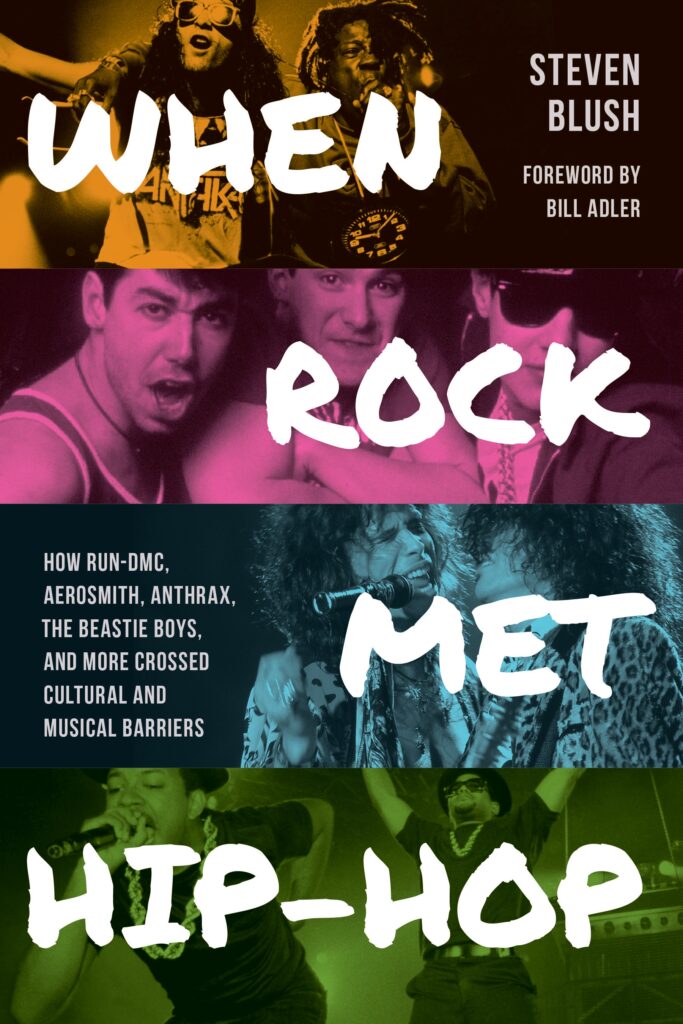
In his latest work, historian and author Steven Blush concludes a trilogy exploring the cross-pollination of rock , disco, reggae, and now hip hop. Known for his book American Hardcore and the movie of the same name, Blush dives into the “New York melting pot” to explain how loud guitars and street beats didn’t just meet, they fused to change the musical landscape forever. I’m Music was able to sit down with Steven to discuss his latest book When Rock Met Hip-Hop.
Tim: This book is a conclusion to a trilogy that started with rock meeting disco and reggae. You mentioned that while rock was “most significant white sound” and hip hop was the “fresh new Black sound,” they shared a common spirit. That kept music from becoming stagnant. What do you feel is the ultimate takeaway with rock meeting these various genres?
Steven Blush: Well, rock gave muscle to a lot of these genres. Disco was kind of like a light, jazzy kind of music, very orchestral. When the Rolling Stones and KISS and all these bands came involved, they were rock bands. They brought muscle to the sound. Same with reggae. I’m not talking about the music of Jamaica. I’m talking about when The Clash or The Police or Blondie or somebody came in there and really gave a heaviness to the sound. The third part in this trilogy is when Rock meets Hip-Hop, and that’s when Aerosmith and Anthrax and Biohazard and then topping it off with Rage Against The Machine, they all brought real power to hip-hop. If you remember, the original hip-hop was “Rappers Delight,” which is kind of like a fun party sound. So that’s what it is. It’s the muscularity of rock brought to various forms of black and non-white music.
Tim: One of the lines of the book is that “hip-hop met rock well before rock met hip-hop.” You talk about DJs in the ’70s using records by Thin Lizzie, Steve Miler Band, et cetera, to create their beds of sound. Why do you think it took so long before this crossover became recognized by the mainstream?
Steven Blush: I think it took a long time for the mainstream to catch on, right? So I think that’s certainly the way it was with all these music forms and most like, what you talked about, is how these the beats and the rhymes of rock weren’t so self-evident at the time and it took many years. It took until now really, you wouldn’t think twice about our rock and hip-hop meeting. You wouldn’t think twice today about putting a rapper with a rock band and that took almost 40 years for it to happen really if you count it today. It started in the mid 1980s. It’s now been 40 years since Aerosmith and Run DMC came together, it was exactly 40 years. So it’s the anniversary of sorts for sure.
Tim: The New York club scene plays such a huge role in this story. What is it about that specific time and place that allowed these two different cultures to start hanging out together in the same rooms.
Steven Blush: Well, there was something called discos originally, but what you had in the early 1980s was something called the rock disco, where you would hear rap music, you would hear dance music, you would hear punk and post-punk, and it was something that was a very unique place in time. There were clubs like Danceteria and the Mudd Club, the kind of places are name checked in a lot of songs and New York it has a lot to do with New York. New York was a place in time where everybody was coming together. I know for myself I didn’t think twice about playing hip-hop and rock together, hip-hop and punk together, hip-hop and hardcore together. It all made sense at the time.
Tim: You mentioned Public Enemy was often compared more to The Clash than to other rap groups. But you also know that their wall of sound production by the Bomb Squad was a studio creation rather than a traditional band setup. In your view, did Public Enemy’s noise-heavy approach actually do more to push the boundaries of rock than the bands who are still just playing guitars?
Steven: Of course. Yeah, they were a mixture of rock and hip-hop. They took the Bomb Squad who had such an incredible approach to music. They were trying to create like you said the wall of sound that was kind of unheard of at the time. Run-DMC, and Public Enemy, compared themselves to The Clash. If you look at it in that terms, it makes a lot of sense. The merger of Anthrax and Public Enemy really took that even up a notch from what even Anthrax was doing alone. So I think it’s this merger of black and white, New York was always multicultural, you know what I’m saying? It was really, nobody even used the word for it. It was just that’s how you lived. And so, Anthrax being a heavy metal band from Queens, which is one of the outer boroughs, on one hand you would say how did that happen? But it’s really just a natural setting, you know? How did The Beastie Boys and Rick Rubin and all these guys, they went to clubs and they heard the merger of all the music and they all stretched the boundaries of punk and hardcore and heavy metal and hip-hop and post-punk and, so it’s really New York, those were the sounds of the streets. That’s what you heard on the street. You heard boomboxes, you heard heavy metal, you heard punk. You didn’t really think twice about it. I think that’s the key to it. I think New York was a melting pot, but nobody called it a melting pot.
Tim: Well, you mentioned The Beastie Boys, and you describe in the book The Beastie Boys as a hardcore punk band that was transformed by hip-hop. Looking at License to Ill, do you think that record was a happy accident? Or was it Rick Rubin’s desperate goal to combine AC/DC style heavy metal riffs with rap rhythms?
Steven: Well, Rick Rubin was the magic of the band. He’s the one who did the production. What they both had in common was they both went to these clubs and they both had this common New York street experience. But it was the magic of Rick Rubin, it took him almost a year to make this record, and what’s really fascinating about that whole period was he was making two records at the same time. He was making License to Ill by The Beastie Boys and he was making Rain and Blood by Slayer. So that’s how you end up with Kerry Kane playing on “No Sleep ‘Til Brooklyn.” So his guitar solos really took that over the top. I say in the book that I’m not sure that was a close relationship between Slayer and The Beastie Boys, but musically it changed the map of music. Probably forever.
Tim: Growing up in the Midwest myself, my introduction to this crossover, if you will, was Run DMC. And so you include a quote from Chuck D, calling Run DMC the complete sacrifice that makes it possible for major labels to see rappers as rock stars. Why do you think their Rock Box and Walk this Way, era was the specific tipping point for this in the industry?
Steven: Well, musically it was the tipping point because they actually had guitars, right? And the loud guitars of King of Rock and Rock Box before the Aerosmith song. But they looked like rock stars. They wore black leather, they talked about tougher than leather. So they really got it right away. There was a New York band called Riot that was considered the new wave of British heavy metal, even though they were an American band, who very influential on Metallica. They were recording in the same studio as Run DMC at the time. So Run DMC picked up a lot of ideas originally from watching this band Riot play. The combination of Run DMC and Aerosmith was probably the most important fusion of certainly the late 20th century, maybe of the whole 20th century. They acted like rock stars. They acted like rock musicians, I should say, and they did it time and again. You just mentioned three albums. That’s most people’s careers. They brought it and they brought it hard. That’s what they shared with the rock bands. I know that’s what got me into it. I’m sure that’s what you related to also.
Tim: Which leads to my next question, MTV. The impact of MTV on this movement because of that video by Run DMC, with Aerosmith and Steven Tyler in the video, and you have that mesh together. That was my introduction.
Steven: Yeah, that is the introduction. And what’s really important about that video is that they’re breaking down musical walls, but in that video, they’re literally breaking down walls. So MTV had a huge part to do with that. VH1 said it was the most important video of the 20th century. I think they’re correct. I think it changed how people looked at music. I think the audiences changed forever. Now you wouldn’t think twice about seeing a rock and hip-hop group. You think about the culmination of all this. like I mentioned before, is Rage Against The Machine, where you literally have Tom Morello playing scratching on his guitar. He’s going full circle and he’s taken the sound of the DJ and incorporated it into a hard heavy metal sound. So, and that’s 1991 or 1992. That’s a long period of time of development. You had, you mentioned earlier, all the work by Run DMC culminating in Aerosmith. There’s Biohazard and and here’s the Judgment Night soundtrack, which is where you had House of Pain playing with Helmet or Cypress Hill playing with Pearl Jam, were really important periods and culminating in, again, in Rage Against The Machine, and then leading to what we now call Nu- Metal.
Tim: Do you think some of this by the 90s became more manufactured than natural by the labels, manufactured by everybody else?
Steven: Well, I think the critics say that. I would say that it started natural, but like everything in the music business, what they do is they they take something and they play it to death and they turn it into a formula. Then they do it until you gotta do something else. Right. So I think it’s two points. I think it’s one that it was natural and then it became totally abused by the record industry.
Tim: You interviewed a lot of individuals for this project. Of all the people you spoke to, was there somebody that you spoke to that a light bulb went off when they were talking to you? A light bulb moment?
Steven: I would say it’s DMC from Run DMC. I mean, he’s the one who kept talking about Billy Squire as being the, he talks about Billy Squire and James Brown as the godfathers of hip- hop.
Tim: What an interesting combination.
Steven: Amazing combination. And you think about the most sampled artist in the history of hip-hop is Billy Squire, over 300 times that he’s been sampled. Let’s be honest, he’s at best middling, fair to middling rock star. I mean, he’s got deep break beats with Bobby Chouinard on drums, creating the big beat on The Stroke and all that. Who thought that one? Who would thought that the most sampled artist in the history of hip hop is Billy Squire? So I think that was a real big, bold moment for me. I just like the way he, I like the way that DMC approaches music. He is a, he’s a rocker, he wears Ramones and Motorhead shirts and, and brings it really hard, you know, and so I really liked his interview. He was a light bulb for sure. A lot of people are really smart in this book though. I think heavy metal and hip hop are kind of the two most disregarded intellectual forms that there are, yet I think in the book, the art is shine. So I could talk to you about Scott Ian from Anthrax. I could talk to you about having Evan Seinfeld of a Biohazard, blew my mind about how smart he was about this stuff. Those guys are from Saturday Night Fever, Brooklyn, you know? This was probably the most important music crossover of our time, and it still goes on today. I think that’s the power of when rock met hip hop.
Tim: Talking about it going on today, when you look at the musical landscape today, at least for me, there doesn’t seem to be barriers anymore or walls anymore. You even got rock, or I’m sorry, rock and country, but you also got rap and country. You have rap and pop, and so it just seems like there’s no more barriers or walls like there used to be anymore. In the music industry today.
Steven: Yeah, well, it was all barriers before that, right. When we were coming up, everything was barriers. Everything was if you like the hair metal bands you couldn’t like a punk band if you liked heavy metal you couldn’t like hip-hop at all I mean it was also a racial thing too. I think it speaks you know politics doesn’t really change the world. Music changes the world. I think that’s a really important thing. I think music has changed the world for the better. I think there’s still a way to go, but the racism that we faced in the 80s and 90s was was far more prevalent than what we have today. You wouldn’t think twice about mixing black and white in music. You wouldn’t think twice about, I think I mentioned before, I don’t think you’d think twice about having a rapper or two in your heavy metal band.
Tim: Look how long it took MTV to play Black artists.
Steven: Oh, yeah, that says it all. It took the music changing so much for them to jump in finally. Remember that was a big thing. They wouldn’t even play Michael Jackson. Then by the end, they were playing Rage Against The Machine, and so it definitely came a long way. Music’s come a long way, society’s come a long way. Not everyone’s happy with the speed in which it’s changing, but change is slow and change is good, and music is more interesting now. You brought up country and hip-hop. I mean, that’s kind of cool.
Tim: Are you working on anything new now? You’re working on anything else right now?
Steven: I have a film that I am working on right now that’s about to hit, I wrote it. I made one other film, I’m best known for a book called American Hardcore about the hardcore punk scene, and I made a film called American Hardcore that went to Sundance and so many pictures of classics and was played at theaters. I just recently worked on a film with the first black hippie. His name was Hiawatha Bailey. He was part of the Detroit rock scene. So it’s got people like Iggy Pop and Patty Smith in it. He was involved with the White Panthers, so it’s a lot of the MC5 members, a lot of the radicals of the ’70s. So it’s called the Song of Hiawatha. It comes out, well, it’ll be in the festivals this fall. That’s what I’ve got immediately. Then I have a third edition of the American Hardcore book coming out in the fall. So I’m pretty busy. I’m keeping it going. And I have been approached about a few rock history books. So I’ll see where that takes me but it never stops. Ten books. I keep going.
Tim: Thank you so much for taking time to do this, wishing you much success not only with this book, but with the upcoming movie.
Steven: Yeah, I really appreciate your time and I appreciate, your interest and, the questions.
Interview by I’m Music Magazine Music Journalist/Photographer Tim Board
WHEN ROCK MET HIP-HOP
DESCRIPTION:
The cross-collision of rock music and hip-hop in the late ’80s and ’90s remains one of the most important events in modern music history. Aerosmith and Run-DMC, the Beastie Boys’ Licensed to Ill, Public Enemy and Anthrax, Rick Rubin and Russell Simmons, De La Soul and House Of Pain, and the more than 300 hip-hop records that have sampled Billy Squier’s “The Big Beat” exemplify the creative possibilities and cultural energy that defined the era. Whether it was rappers repurposing rock albums to elevate sampling into an art form, rock musicians deploying hip-hop techniques in the search for new sounds, or collaborations between heavy hitters in both genres, it was a cultural moment that altered the course of popular music. Along the way, it revealed and challenged sociocultural fault lines, suggesting possibilities for interracial harmony while confronting complex histories of exclusion and exploitation.
Drawing on the same cross-genre enthusiasm in author Steven Blush’s books When Rock Met Disco and When Rock Met Reggae, this fascinating survey of the rock-rap collision illuminates a cultural explosion that changed music for the better and remains an influence today.
BIO:
Steven Blush has written seven books about rock and pop culture—including American Hardcore (2001), American Hair Metal (2006), 45 Dangerous Minds (2005), Lost Rockers (2015), New York Rock (2016), When Rock Met Disco (2023), and When Rock Met Reggae (2024)—as well as one about Billie Jean King’s rebel tennis league, Bustin’ Balls (2020), currently in television development. He wrote and produced the theatrically released, Sundance-premiered documentary American Hardcore (Sony Pictures Classics, 2006), followed by an expanded second edition of the American Hardcore book, now available in five languages. He lives in New York.