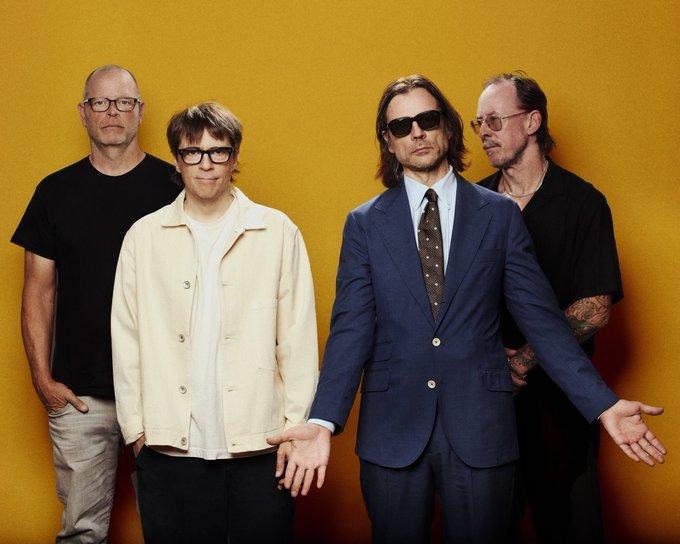
Picture this: A fading Los Angeles evening, the kind where the sky melts into a bruised gradient of lavender and rust. The streets are humming with the leftover static of the day, and somewhere in a cramped rehearsal room off Santa Monica Boulevard, four young men are tuning their instruments like they’re trying to tune their futures. Backlit fluorescent lights flicker. The amps crackle. And then, almost shyly, a sound emerges.
Weezer returns!
The band who ignited a frenzy of talk nearly 30 years ago with the release of the video for their song, “Buddy Holly”. A revolutionary visual masterpiece that had them recreating the beloved Happy Days sitcom, which aired during the 70s and 80s. Yes, it’s 2026, and they are still going. After years of experimentation, fanatic fandom, and a conviction to creating music only the Weezer way. They return with the release of The Gold Album. Keeping with the Weezer color theme, The Gold Album feels like a reckoning. A gilded confrontation with legacy, longing, and the strange burden of being a band that fans want to freeze in time.
Anyone familiar with Weezer knows of the legendary Color Albums. An era of a strange, beautiful, self-mythologizing tradition that became their most recognizable signature.
Green was rebirth. Red was rebellion. White was sun-bleached innocence. Teal was nostalgia incarnate. Black was descent into darker pop textures.
By 2026, the palette had grown so iconic that Weezer released the Weezer Coloring Book, a vinyl box set collecting all six color-themed albums, complete with a 72-page illustrated book and matching markers. Sharing a literal invitation for fans to color in the band’s history.
The colors weren’t just branding. They were identity. They were evolution. They were the emotional spectrum of a band forever trying to understand itself.
At the center of this kaleidoscope stands Rivers Cuomo, the architect of Weezer’s sound, the keeper of its anxieties, the reluctant protagonist of its mythology.
He writes like a man trying to decode his own heart. His lyrics oscillate between confession and satire, longing and absurdity, sincerity and self-mockery. He projects a haunting of the ghost of his younger self. The kid in the garage who just wanted to write songs that felt true.
Weezer’s journey has never been linear. It’s circular. A band returning again and again to the emotional garage where it all began.
Produced with Kenneth Blume (Kenny Beats), The Gold Album abandons polish for pulse. The band wrote together in a living room, rehearsed in a humble Orange County space, and recorded with amps cranked and imperfections intact. It’s the closest they’ve sounded to Pinkerton or Maladroit in decades, not because they’re imitating the past, but because they embraced the bravery to confront it. It feels like a return to the room where it all started.
With the collective creativity of Rivers Cuomo on lead and backing vocals, guitar, and Brian Bell on guitar and backing vocals, Scott Shriner on bass, and Patrick Wilson on drums, Weezer takes every opportunity to craft songs that might be mirrors into not only themselves, but aspects of all of us.
“Say Yes” opens the album with an irresistible hook. Rivers Cuomo questioning his worth, his place, and his legacy. It feels like a confession that’s being whispered into the glow of a studio console. It gives this weary, self-doubting feeling, but while still reaching for transcendence.
“C.E.O.” is satire wrapped in nostalgia, echoing the DNA of “Undone, The Sweater Song” while openly lamenting the expectation to recreate the ’90s forever. It’s nostalgia with teeth. A man haunted by the ghost of his own youth and successes.
“We Might as Well Be Strangers,” featuring Wednesday’s Karly Hartzman, is the emotional apex of the album. Cuomo sings, “Happy birthday / Thanks for the Valium,” a line that lands like a sigh from someone who has lived long enough to know that joy and sorrow often arrive holding hands.
Weezer’s awkward, nerdy charm remains intact. “Hoops” turns scanning a QR code into existential comedy. “Nowhere” critiques California sprawl with a distorted riff and a Joni Mitchell meets Kyuss type of spirit.
These are songs written by men who have grown older but not necessarily wiser, and that has been Weezer’s beauty over the years. The emotional palette is middle-aged uncertainty, combined with suburban absurdity, and the bittersweet ache of remembering who you used to be. In only the way Weezer can deliver, there’s humor, hurt, and humanity.
The closer, “The L.A. Sound,” written by Brian Bell, is a nostalgic love letter to the band’s early days. Nights spent in crappy clubs, long van drives, melting faces with earnest alt-rock distortion. It’s mythmaking, yes, but also myth nostalgia. A band honoring the road that carried them here, and a golden farewell to the road behind.
The Gold Album isn’t perfectly polished, and it doesn’t try to be. Its imperfections are part of its charm, part of its humanity. This is Weezer reckoning with their own story, embracing the tension between past lives, past successes, and who they’ve become.
It’s a late-career album that is absolutely a mirror. There are cracks, honesty, and shimmers with the gold of everything they’ve survived. After a few listens of The Gold Album, and when the credits roll, you’re left with the sense that Weezer, for all their colors, all their eras, all their reinventions, has finally made peace with the ghost they’ve been chasing since that first California night.
I’m Music Magazine Music Journalist Jon Faia

You can connect with Weezer on the road in a town near you and find exclusive fan information at the Weezer Official Site
TikTok
X/Twitter
https://www.facebook.com/weezer
https://www.instagram.com/weezer
YouTube