While the music industry itself has traditionally been about big business, the artists that make its world go round have always seemed larger than life. And, if you’ve ever wondered what might happen if those larger than life artists banded together for a cause, you may not be alone. Now, there have been some attempts to make a difference by music industry artists, who could forget “We Are the World” or the Band Aid project, “Stars”, but I want to highlight a movement that not only had immediate impact on America, but a lasting impact that is still felt today.
In the fading dawn of 1990, the modern music industry found itself under an unprecedented, reactionary siege. Censorship watchdogs, legislative grandstanding, and restrictive parental advisory warnings threatened to suffocate any attempt at sonic expression. There was an aggressively enacted war targeting hip-hop pioneers, heavy metal trailblazers, and provocative pop icons alike. In response to this rising tide of artistic suppression, visionary music executive Jeff Ayeroff, alongside a determined coalition of industry allies, realized a fundamental truth: standard defensive court battles and passive press releases were never going to be enough to save artistic free speech. The ultimate equalizer against institutional control wasn’t a corporate statement or a legal brief; it was a ballot.
Music fans, welcome to the birth of Rock the Vote, a pioneering nonpartisan initiative designed to channel the raw, unbridled energy of youth culture into real political power. By converting crowded concert venues into mobile voter registration hubs and leveraging mainstream broadcast airwaves, the movement successfully fused a passion for music with active civic participation.
Since its inception in Los Angeles, in partnership with the MTV broadcast network, the organization grew into a formidable legislative force. Its tireless grassroots efforts proved pivotal in pushing the landmark National Voter Registration Act of 1993, famously known as the “Motor Voter” Act, into federal law. This was a huge milestone in simplifying the voter registration process across the country. Over the course of its history, the organization has mobilized over 14 million young voters, fundamentally reshaping how youth culture intersects with American policy.
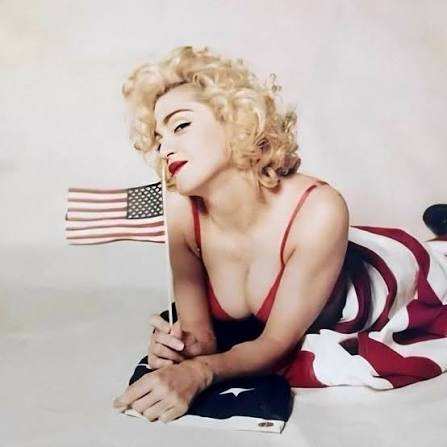
The storied history of youth mobilization is permanently written in culturally iconic milestones. In late 1990, Madonna wrapped herself boldly in an American flag for a groundbreaking public service announcement, commanding viewers with her signature poetic urgency to exercise their fundamental democratic rights.
When MTV forged its historic alliance with the campaign, traditional political media coverage transformed overnight. Cable television opened up candid town hall spaces where young, disenfranchised audiences could directly challenge presidential hopefuls on real issues plaguing America like economic equity, healthcare rights, and civil liberties.
As media evolved, so did the movement’s strategy. By 1996, Rock the Vote launched the internet’s very first online voter registration platform, laying out the blueprint for digital organizing decades before social media existed. In subsequent years, campaigns like the viral “Turn Out For What” initiative bridged pop culture and activism for a new generation. These moments proved that true civic engagement has to continually adapt alongside emerging technology and shifting media landscapes to maintain its pulse. Rock the Vote may have begun as flag-wrapped public service announcements, but quickly evolved into digital drives.
To understand why artists felt compelled to step off the record sleeve and onto the political frontline, we have to understand the unique space musicians occupy in human culture. Unlike traditional politicians or corporate mouthpieces, artists hold an unfiltered, highly personal relationship with their audience. Music is emotional shorthand; a three-minute track can articulate systemic anguish, existential dread, or the rebellious joy of a generation far better than any policy brief or congressional debate. As politicians began bowing to conservative lobbyists, they initiated labeling lyrics as illegal and criminalizing record store clerks for selling explicit albums. Artists quickly realized that creative expression was under an existential threat. Protecting the microphone meant protecting the rights of the audience listening to it. The musical landscape became a modern-day form of artistic “McCarthyism”.
Musicians quickly realized they possessed unprecedented cultural capital. While traditional political campaigns struggled to connect with disenfranchised young people who felt ignored by the American legislature, musicians were already filling stadiums, dominating airwaves, and shaping modern culture. They held the trust that political institutions had squandered. By stepping up, musicians didn’t just advocate for voting; they demystified it. They transformed the act of voting from a bureaucratic chore into an extension of self-expression, allowing young people everywhere to proclaim their beliefs and identity with civil defiance. When musical icons like Chuck D (Public Enemy), Kurt Cobain (Nirvana), or Eddie Vedder (Pearl Jam) told fans that staying home was a surrender to the status quo, civic participation became an act of rock ‘n’ roll rebellion. The music industry understood that if it failed to mobilize its audience into a formidable electoral block, political power structures would continue to silence youth culture with impunity, and kill the spirit of free speech.
Voting should never merely be thought of as an administrative obligation, but rather a rhythmic reckoning. Every marked ballot acts as a vital, stabilizing beat in the broader, sweeping cadence of history. When young voters step up to the microphone of democracy, they don’t just participate in the cultural zeitgeist; they fundamentally rewrite the entire score.
Yet, in today’s fractured climate of digital noise, our cultural ecosystem is in desperate need of a synchronized mobilization effort. Regardless of where we lean in our political opinions, there is no disputing that America is experiencing hyper-polarization in our communities, but in most cases, music is and can be our welcoming handshake.
A reimagined, hyper-charged cultural movement akin to the original heights of Rock the Vote is not only helpful but is an absolute necessity to bridge the gap between passionate online commentary and actionable political power. When music validates the frustration of youth culture, it acts as a gateway, transforming raw anger into structural change through active participation. That’s why it was so important for Rock the Vote to build partnerships with established stars to convince a generation that their voice did matter, and their opinions had the right to be heard.
Across four decades, a diverse lineup of musical creators and cultural icons have continually stepped forward to champion this exact ethos. So many of the artists we champion and love have taken their turn as modern mobilizers from stages across the world to the voting booth.
Every modern genre of music has seen its stars take up the mantle for change. R&B & Pop Visionaries like Christina Aguilera, Janet Jackson, and Alicia Keys have leveraged massive benefit concerts and targeted awareness campaigns to emphasize how local legislative measures directly impact community equity, reproductive freedom, and public education.
Hip-Hop Trailblazers have had a long tradition of systemic critiques of racism and civil rights concerns by Chuck D to viral multi-platform movements like Lil Jon’s “Turn Out For What” campaign, hip-hop culture has relentlessly highlighted institutional inequality and driven massive voter registration surges.
There may be no bigger name in musician activism in the last 30 years than Rage Against the Machine’s Tom Morello. Morello recently founded the “Power to the People Festival”. Inspired by the nearly 85 years of activism by his late mother, Mary Morello, Tom has made every effort to illustrate the timeless, indestructible link between heavy distorted riffs and organized civic power. Morello curated the monumental “Power To The People Festival” at Maryland’s Merriweather Post Pavilion. Featuring an unprecedented, star-studded coalition including Bruce Springsteen, Joan Baez, Public Enemy, Dave Matthews, Cypress Hill, and the Foo Fighters.
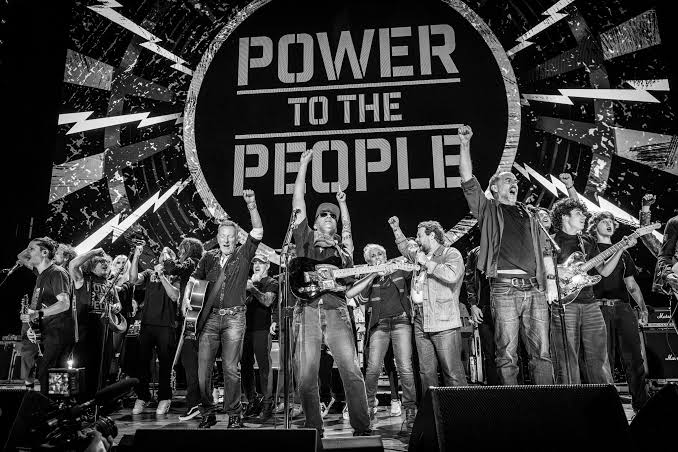
The event anchored its high-decibel sonic protest to direct real-world action. Framing the festival grounds with an on-site “Freedom Village,” the event partnered directly with vital grassroots organizations like HeadCount and VoteRiders to register voters, educate attendees on changing voter ID laws, and turn urgent collective frustration into structured political power.
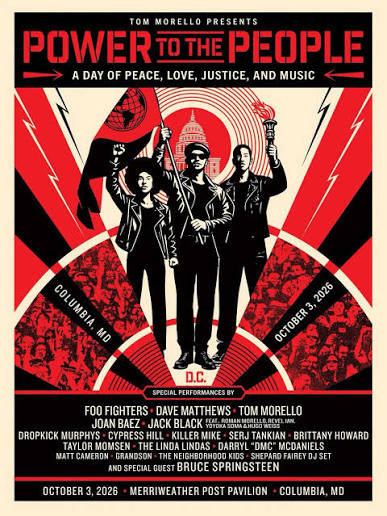
When musicians band together for a cause, they do more than play notes; they forge solidarity that bypasses political cynicism. From major festival tours pausing sets so fans can register to vote at booth stations, to independent artists leveraging fan direct streaming platforms to preach civic literacy, the modern music ecosystem is increasingly embracing its role as a frontline driver for social change. Labels, managers, and venue networks are now integrating voter registration tables directly into tour riders and ticket checkout pages, proving that when the industry mobilizes its infrastructure, art becomes a powerful engine for real-world democracy.
While the current cultural moment demands more than passive viewership, active creation is desperately needed. With the help of artists using their global platforms to champion civic literacy, they strip away the intimidating bureaucracy of politics and make participation a shared cultural value. It’s time to reclaim the future soundscape and make change a social imperative.
As the final feedback fades and stadium lights dim, the true test of any movement lies beyond the encore. Music has always provided the sanctuary where our collective grievances find melody, but democracy demands that we carry that harmony out of the arena and into the polling booth. The songs we sing today are the blueprints for the world we inhabit tomorrow; they are the reverberating echoes of a generation refusing to be silenced. Whether you’re discovering Woody Guthrie or Rage Against the Machine, when the bass drops and the crowd disperses into the evening air, remember that the most revolutionary act isn’t merely screaming into the amplifier, but stepping up to the ballot box to compose the future ourselves. Activism and civic rights aren’t a fad, and one artist’s view may not be yours, but one thing we can all agree on is that while Rock the Vote jumpstarted a movement to voter registration among young people, the opportunity to vote and be heard might be our greatest liberty. A choice is a gift, and it doesn’t matter if it’s Madonna, Aerosmith, or Pearl Jam asking you to get out and vote; take them up on it, change the world.
https://www.instagram.com/reels/DeCbeDDxy9u
For those looking to participate meaningfully in upcoming elections, stay informed through official, transparent resources:
- Explore civic guidelines and voter registration status via the U.S. Election Assistance Commission.
- Learn about youth-led voter outreach, digital tools, and registration campaigns through Rock the Vote and HeadCount.
We’d love to hear from you and learn what album, artist, or live performance first inspired you to take a definitive stand for social causes in your own community.
I’m Music Magazine Music Journalist Jon Faia