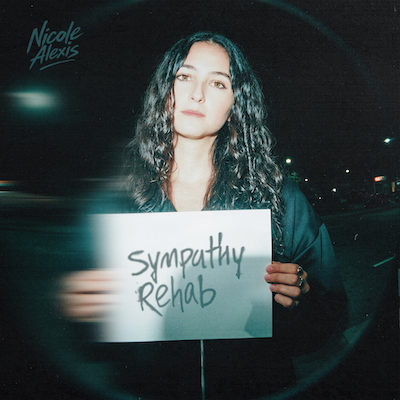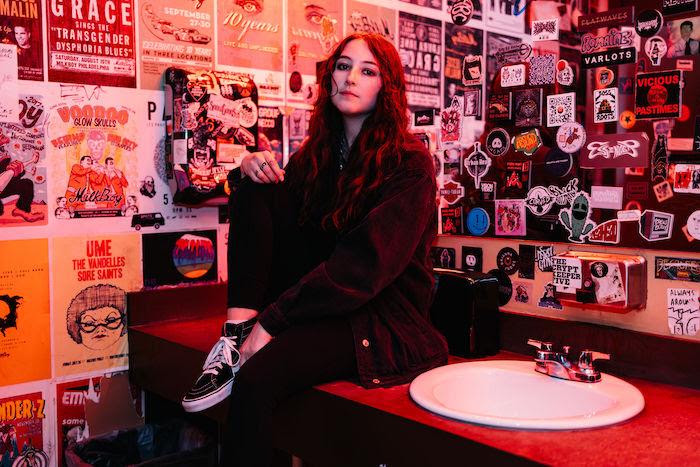
She started out in Nashville working as a songwriter and producing others, Nicole Alexis is now doing all those and more for herself. Hundreds of listeners first “discovered” Nicole through stripped down short form social videos of acoustic interpretations of bands like Dashboard Confessional, My Chemical Romance, and Smashing Pumpkins. New fans are discovering her through her EPs Mirrors and Smoke and Sympathy Rehab, the latter just dropped on 9/25. Nicole visits with I’m Music Magazine’s Tim Board to talk about her career, the EPs and much more.
Tim Board: For years you worked in Nashville as a songwriter and producer for other artists before stepping forward as a solo artist. What was the moment or turning point where you decided, “I need to stop giving these ideas away and start saving the rawest ones for myself”?
Nicole Alexis: I think it was probably mostly when I couldn’t let go of a lot of the ideas I had. I would get into a room and be trying to think off the top of my head, “Oh, I wrote this really great idea last night, but I don’t want to give it away.” So that day I would have to try to think of something new. I think when I started to become protective over the ideas and what I wanted to say, and I wasn’t able to really see anybody else’s voice in the songs, that’s when I realized this was probably something I should dive into a little more. Being a writer, producer in Nashville is really fun because you get to meet so many different artists and be in different genres. But at the end of the day, I was so protective over my songs, and I wanted to be the one to be the vessel for them.
Tim: You’re known for handling every aspect of your creative chain, from writing, tracking, and producing to engineering your own records. When you’re sitting in a home studio playing every instrument, how do you know when a track is truly finished versus when you’re just over-analyzing it?
Nicole: I think when I get so tired that I have to go to sleep is normally my stopping point, because I don’t think there’s ever really an end to it. Recently I’ve been so caught up on mixing the songs and getting the mix right, because I don’t have any formal training in engineering, so a lot of the time I’ll just try to do it over and over again. At a certain point, it’s enough is enough, and I think that point is when I start to hate the song because of how many times I’ve listened to it. There really isn’t an end to it, it’s just about getting to the point where I can’t hear it anymore.
Tim: Do you have a mentor or somebody you have listen to the song and give you feedback?
Nicole: I do have a couple of really close family members and friends that I trust to listen to the music and give me that yes or no on whether it’s a good idea. My brother just moved to Nashville, he goes to Belmont University. He’s an incredible guitar player and artist himself, and he’s been great to have here because he helps me bounce ideas off of him. He’s been pretty helpful in that.
Tim: As a producer and a songwriter, how do you balance the fact that as a producer you need to make changes, but as a songwriter you don’t want to change the song?
Nicole: Yeah, it’s definitely a challenge. I think that’s probably why, over the past couple of releases, I’ve tried to dial back a lot on the production. I’ve done a little bit of everything on the production side, from old pop and EDM styles to country and folky stuff. So the past couple of releases, I have intentionally been a little more stripped down, because I wanted to focus on the songs rather than the production. Recently, songwriting has become something I’m more interested in as a whole. It’s definitely a tricky balance.
Tim: You mentioned stripping some of that away, and on your recent EPs, Mirrors in Smoke and Sympathy Rehab, you leaned heavily into acoustic-driven, alternative arrangements. You’ve mentioned in the past that after spending hours on heavy production, sitting down with just an acoustic guitar often felt more authentic. How does simplifying your setup change the way you approach writing a song from scratch?
Nicole: Because I’m a massive over thinker, and if I have too many options, I’ll overthink every possibility possible. So I would intentionally give myself an out by just sitting down with an acoustic song or acoustic guitar and whatever I’m feeling, just write it and then let that be the song and don’t think too much on productions and stuff. Doing that has let me say basically what I want to say without the analysis paralysis of trying a million different ideas. So simplifying has definitely been my keyword recently.
Tim: Your EP Mirrors and Smoke seemed to capture the cycle of holding on to unhealthy relationships, whereas Sympathy Rehab feels like a record about finding clarity, setting boundaries, and processing frustration. Looking at these two EPs, do you feel like Sympathy Rehab is the answer to the questions you were asking on Mirrors and Smoke?
Nicole: Kind of. I don’t know if if it ever happened, the answers. I think that throughout all the music it is always going to be an evolution of self-reflection and self-discovery. A lot of it is very internal-struggle driven. It’s just me sitting down in my basement with an acoustic guitar, trying to process why I act, or do, or feel a certain way. So it does feel like a little bit of an answer to the Mirrors and Smoke project, but it’s still more about self-discovery. Even with the upcoming music, it’s going to continue to be that way, it’s a constant evolution.
Tim: Was it difficult to share that vulnerability of yourself?
Nicole: Totally. I don’t love sharing a lot of my music with close friends and family, because I don’t want them to think I’m struggling. But its more the struggle is in the lyrics, it’s less about what I’m currently feeling about a situation. It’s the afterthought, after the fact of going through a situation. So it’s definitely tough to share some of these songs with friends and family, but they know it’s not a current struggle, it’s a past one.
Tim: I was going to say, how do you express to your friends and family that it isn’t a current struggle?
Nicole: I’ve been writing music since I was about 13 years old. I think when I first shared music with them, they’d be concerned. By the time I’d been sharing it with them for a while, they were more like, “Alright, this is either really concerning, or you just have a lot on your mind.” I think they’ve definitely gotten used to me sharing vulnerable songs with them, but every now and then I still feel like, “Okay, this isn’t me right now, this is me five years ago,” or whatever the situation was.
Tim: On your single “Broken,” you chose to put out both a full-band version and an acoustic version. Why did you decide to release both versions?
Nicole: Yeah, that song is very vulnerable in the sense that it hits so hard when I play it acoustically, the feeling really comes through. But when I do things acoustically, it tends to lean a little softer, but I feel the song itself is pretty angsty, so I wanted the feeling of the lyrics and the vibe of the song to be in the production and full-band version. Having the two allowed me to explore the song more deeply than if it had just been one or the other. I wanted to give the vulnerability of the acoustic version and the angst of the full band.
Tim: So when you release these vulnerable songs, do they offer you a sense of closure afterward?
Nicole: In certain ways, they do. There was one song I had called “Don’t Tell Me to Breathe,” and when I wrote it, I didn’t actually know what I wrote it about. I was just frustrated with something and writing out of that frustration. When I finished the song and started thinking about what it was about, it helped me understand a little more about my brain and why I react to certain situations the way I do. When I write something, it’s more of an “aha” moment, because writing for me is more of a stream-of-consciousness thing. I never sit down with an idea, I just sit down and say whatever’s on my mind. So when I come out of it with a song, I usually understand myself a little bit better.
Tim: You’ve spoken before about managing the chaos of an ADHD brain while running a completely independent music project. How do you channel that frantic creative energy into the strict technical discipline required for recording and production?
Nicole: I think the hyper fixation part of ADHD takes over a lot in those situations. I’m such a perfectionist that if everything feels chaotic, I’ll hyper fixate on one thought or idea until it’s perfect. So when it comes to producing, I can’t sleep until I figure out which EQ plugin is going to be best for my vocals and stuff. It’s a combination of years of developing the skills and hyper fixating on them, plus the anxiety that the ADHD is caused. It definitely takes over and I’ll get very anxious about not finishing a song or not posting a video, so I think that kind of takes over at that point.
Tim: Your trajectory has taken you from viral performances in parking garages and bedroom setups to playing major stages like Vans Warped Tour Unplugged. How do you translate the intimacy of a stripped-back, one-person looping session to a full festival crowd?
Nicole: It’s definitely difficult, because looping is essentially taking four or eight bars of a song and looping it over and over again. I’ve been trying to develop that in a way where it doesn’t feel so repetitive, bringing new instruments in and out and feeling out the crowd. If something’s been going on for too long, I’ll take it out and bring it back in later. It’s been a developing process, especially with the looping, because it can get repetitive really fast. So I experiment with filtering things in and out, and the practice of doing it live is an ever ongoing project of mine, for sure.
Tim: How do you retain the personalization and vulnerability of the songs when moving from an intimate environment to a large crowd at a festival or venue?
Nicole: Yeah funny enough as much as I love the stripped-back acoustic stuff, I also love rocking out and playing with a full band. I have a drummer and a bass player I play with, and I love guitar solos too. It feels more like a three-piece jam in a live setting, and we have a lot of fun playing a beat song, or taking ones that I’d typically play acoustic and turning them into a full-band vibe. It’s been really fun playing around with the arrangements for the song live, especially in club venues.
Tim: Do you see yourself down the road bringing in more of a band setting for recording songs, or do you think it will still just be you, acoustic and stripped down?
Nicole: Down the road, I definitely have a goal of doing live band sessions. I think allowing other people into the process, and allowing myself to just focus on the songs and the main melodies, is where I’d like to be. I don’t necessarily want to do everything myself, because if I can focus on the music, I think I can give a better performance than if I’m caught up in the technical side of things.
Tim: Do you feel like being solo, stripped-down, and acoustic sometimes limits you, or do you feel like it still gives you greater creativity?
Nicole: I wouldn’t say it limits me, but when I get together with a band, I do have a different style of writing, my guitar riffs end up being a little more creative, because when you’re bouncing ideas off other people, it’s not just your ideas anymore, it comes from the room. It’s definitely a different style of writing, but I will say when I’m alone with an acoustic guitar, I feel more open to saying whatever’s on my mind versus with other people. I’m a little more shy about it, I guess.
Tim: You’ve had brands like Fender sign off to feature your music, yet you’ve remained independent without a major label behind you. As the industry shifts, what does staying independent allow you to protect creatively that you wouldn’t be willing to compromise on?
Nicole: It really comes down to releases. I’m very spontaneous when it comes to releasing music. I just want to get the songs out there, and I’d never want to be restricted on when or what I could release. I think that’s the most sacred part of it, and it’s the cool thing about being in the position I’m in now.
Tim: As an independent artist, what are some of the biggest frustrations for you?
Nicole: Well, I actually recently signed a deal with Hardworking Records, and that’s been awesome having the help of other people to bounce ideas off of. It’s really cool because they understand me and my music, and they want to release as much as I do. It’s cool to have the resources and help of other people while still being able to release what I want, when I want. That’s been really cool.
Tim: You’ve said you’ve written hundreds of songs, but only certain ones survive that process and make it into the world. What separates a Nicole Alexis song that you decide people need to hear from what remains on your hard drive, in your notebook, or on your phone?
Nicole: It takes me a very long time. I’m very critical over the music that I write, so it takes a long time for me to actually like something. It could be weeks or months go by and then I’ll think about a song I wrote a couple weeks back and think, “Oh wait, I can’t get that melody out of my head, I should revisit it.” So if a song doesn’t leave my mind after a couple of weeks, then it grows on me, and I decide I like it. But it’s always hard to take something I wrote and decide right away that I like it a hundred percent. It definitely takes time for me to get familiar with it and enjoy it.
Tim: What do you hope listeners understand about you after hearing Sympathy Rehab from beginning to end?
Nicole: I hope they understand that as a person, the older you get, the more you understand about yourself, and the more you understand about yourself, the more you’re able to grow and realize trends that might be unfavorable for your life. So I think my biggest takeaway from this EP would be: never stop trying to make things better for yourself, growing, and understanding yourself.
Tim: You talked about growing up being treated as a girl guitar player who belonged in the background, and eventually deciding that you didn’t want to be the girl in the band, you wanted to be the band. What did you have to change internally before you actually occupied that space?
Nicole: I had to let go of a lot of doubt. I’ve been playing guitar since I was about nine years old, and I never felt like I was a good enough guitar player in any of the bands I was in to play lead or take solos, but in actuality, I probably was. I held a lot of doubt, and I held myself back a lot from really playing the lead and being a good guitar player. Even with singing, I didn’t start until I was about 15, because I was so shy about it. I had to let go of a lot of doubt and allow myself to be bad before I could be good. Once I did that, the consistency of writing, posting, and playing live definitely helped my confidence.
Tim: Was there a certain “aha” moment that led to that discovery for you?
Nicole: Not really. I think it was more of a constant question over time like, why are all my peers so comfortable being the frontman of a band, when I feel like I’m just as good, but I’m not in the place I want to be? So it was more about allowing myself to become comfortable over time and stepping out of my box a little bit.
Tim: I want to thank you for taking the time to do this. I greatly appreciate it.
Nicole: Yeah, no, thank you for calling; I really appreciate all your questions.
I’m Music Magazine Music Journalist /Photographer Tim Board